Overview & Real-World Use
I've been building internal tools, client-facing portals, and SaaS back-ends for going on twelve years now, and I'll be honest: half the time my agencies waste two to three weeks just getting a decent admin shell standing before we even start touching the actual business logic. Rizz v1.1 cuts that out of the equation entirely.
This is a Bootstrap 5–based admin and dashboard template, but what actually sets it apart in the crowded "free-ish HTML dashboard" space is the breadth of framework variants it ships with. You're not just grabbing a pile of HTML files. The package includes implementations in React.js, Angular 18, Vue 3, Svelte 4, Laravel 11, Django, Symfony 7.0, CodeIgniter, Cake PHP, Node.js with EJS, and vanilla PHP. That means whichever stack your shop runs on, you get a ready-to-drop-in template layer instead of starting from a bare admin boilerplate.
In practice, I've found it most useful for three project types: internal project-management dashboards for mid-size teams, lightweight SaaS admin panels where you need role-based views and a clean data table setup, and back-office panels for small eCommerce operations that don't warrant a full WooCommerce build. If your client says, "I just need a pretty admin area that tracks orders and user accounts," Rizz gets you to 80% in an afternoon.
Design & Layout Workflow
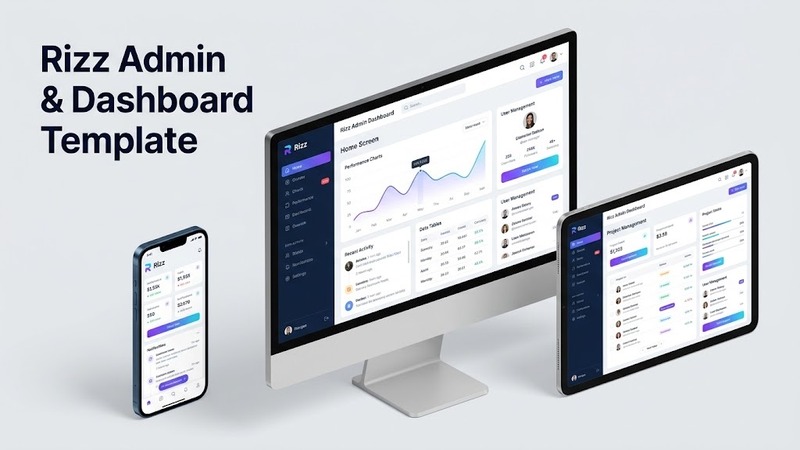
The visual language here is straightforward and modern without being flashy. Rounded cards, a subdued color palette with a single accent, and generous whitespace. It doesn't scream "startup on a rocket ship." Instead, it reads like a professional internal tool that a finance team or ops manager would actually use all day without getting eye strain.
The sidebar navigation supports multi-level menus, collapsible sections, and active-state highlighting out of the box. The top bar handles notifications, search, and user dropdowns. What I appreciate is that the grid structure follows Bootstrap 5 conventions cleanly, so if you need to add a custom widget column or drop in a chart library, you're working within a predictable 12-column system rather than fighting a proprietary layout engine.
The demo pages included in the template pack cover a solid range: standard dashboard overview with stat cards and mini-charts, user management tables, a settings/preferences panel, an e-commerce order list, a project kanban-style board, and a couple of auth screens (login, register, forgot password). Each one is a fully coded page, not a Figma mockup you have to rebuild. For our agency, that means a junior dev can spin up the base structure while I wire up the API endpoints, and we're parallel-tracking instead of doing everything sequentially.
Practical Functionality
Under the hood, the template relies on Bootstrap 5's JS bundle for modals, dropdowns, and the off-canvas sidebar, plus a handful of utility plugins for things like sweetAlert-style toasts and data-table sorting. Nothing heavy. No jQuery dependency in the React/Vue/Angular variants—they use framework-native state management for interactive elements, which keeps the bundle footprint lean.
Responsive behavior is handled through Bootstrap's breakpoint system (576px up to 1400px and above), and I've tested the mobile collapse where the sidebar tucks away and the nav switches to a hamburger trigger. On a 375px-wide phone frame, the stat cards stack vertically, tables get horizontal scroll, and the top bar compresses down to icon-only. It works. It's not pixel-perfect on every micro-interaction, but for an admin panel that's primarily desktop-consumed with occasional mobile checks, it's more than sufficient.
If you're deploying the Laravel or Symfony variant, the routing and controller scaffolding is already wired so your dashboard routes map to the views without rewriting URL structures. The React and Vue versions come with sensible component splits—Sidebar, Topbar, CardGrid, DataTable—so you can lift individual pieces into an existing SPA without dragging the whole template along.
Technical Specifications
| Item | Detail |
|---|---|
| Base framework | Bootstrap 5 (v5.3.x) |
| Available in | HTML, React.js, Angular 18, Vue 3, Svelte 4, Laravel 11, Django, Symfony 7.0, CodeIgniter, Cake PHP, Node.js (EJS), PHP |
| PHP requirement | 8.1+ (Laravel / Symfony / CodeIgniter / CakePHP variants) |
| JavaScript | ES6+; framework-specific loaders for React/Angular/Vue/Svelte variants |
| CSS architecture | Bootstrap 5 utilities + custom SCSS overrides |
| Demo pages included | Dashboard, User Mgmt, E-commerce Orders, Project Board, Settings, Auth (Login/Register/Forgot) |
| Documentation | Setup guides per framework, variable reference, and changelog in the root folder |
| License | Commercial use permitted; check vendor terms for redistribution |
Final Takeaway
Rizz v1.1 isn't trying to be a full CMS or a page-builder theme. It's a clean, multi-framework admin shell that saves you the tedious work of styling a dashboard from scratch. If your team already commits to React, Vue, or Laravel and needs a credible-looking back office without hiring a front-end designer for two weeks, this is a practical, low-friction starting point. It won't impress a client with award-winning animation, but it will get a functional, professional admin interface live fast. For agency workflows where you're juggling five or six concurrent projects, that speed alone justifies the download. Just don't expect it to replace a full product design system—pair it with your own brand tokens and component overrides, and it becomes genuinely useful.