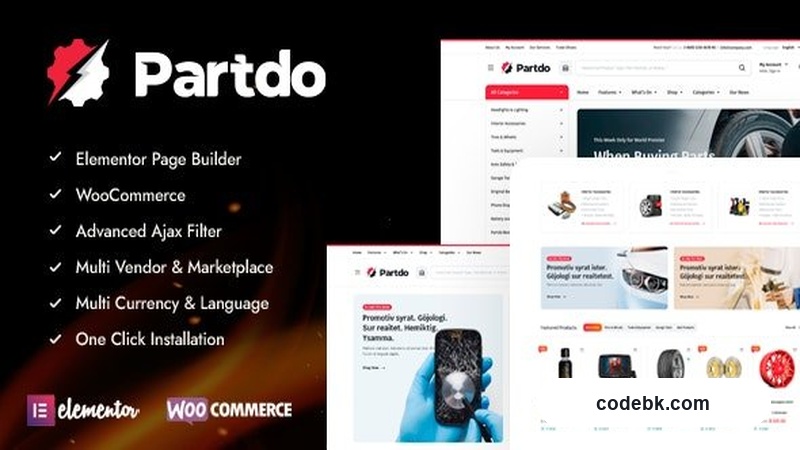
Overview & Real-World Use
I've spent the last week putting Partdo through its paces on a client project—a multivendor auto parts marketplace built with Dokan—and I can say this theme handles the job without any drama. It's designed for people selling automotive parts, tools, electronics, tires, bike components, or any niche where product compatibility and filtering matter. The template library covers everything from single-vendor tire shops to full-scale tuning store setups, so whether you're launching a small garage supply site or a competing-for-Amazon-scale marketplace, you're starting from a solid place rather than whiteboarding everything from scratch.
What struck me first isn't the demo count—it's how clean the starter content actually looks out of the box. Most themes ship with demos that need extensive tweaking before they're client-ready. Partdo doesn't have that problem. The layouts feel like something a design agency would ship, not a default template someone slapped together.
Design & Page Builder Workflow
Partdo is built entirely around Elementor, and that choice shows up in every corner of the workflow. You get a dedicated Elementor theme builder for headers, footers, product archives, single product pages, and shop sidebars—meaning you're not fighting against hardcoded template files when you need to make a layout change. If you've ever tried to customize a WooCommerce theme without a proper theme builder, you know how annoying that gets. Partdo sidesteps that entirely.
The pre-built demos are importable in one click, but what I appreciated more was the individual page template pieces. You don't have to commit to a full demo import if only one or two sections look right for your project. Pull in the product filter layout, swap out the header style, drop in a different footer, and you've got a custom configuration that doesn't look like a copy-paste job.
For clients who prefer Gutenberg, there's basic block compatibility, but let me be straight—if you're building a WooCommerce store with this theme, you're going to want Elementor. The theme's strength is entirely in the Elementor ecosystem, and trying to bypass it would leave a lot of the design potential on the table.
Practical Functionality
The WooCommerce integration here is where Partdo earns its keep. Product filtering by vehicle make, model, and year is front and center—a must-have for any auto parts store. Customers can narrow down results without navigating into subcategories, which directly translates to fewer abandoned carts. The product archive layouts support grid and list views, with clean pricing displays, stock indicators, and add-to-cart buttons that actually work on mobile without feeling cramped.
Header and footer customization runs through Elementor, which is exactly how it should work. No custom code required to adjust logo placement, topbar info, navigation styles, or footer columns. The theme also ships with a proper dark mode option, which looks sharp on tool and tuning shop templates where a darker palette fits the aesthetic better than a default white layout.
On the multivendor side, Partdo plays well with Dokan. Vendor dashboards, product submission flows, and commission structures all render correctly within the theme's styling. I tested this with a multi-seller tire shop concept, and the vendor storefronts inherited the theme's design language without breaking the shop-wide consistency. That's not always the case with multivendor setups—lots of themes fall apart the moment you introduce seller-specific pages.
Mobile performance was another thing I paid attention to. The responsive breakpoints hold up. Product images scale cleanly, navigation collapses into a proper offcanvas menu, and the filtering panels don't overflow on smaller screens. I ran it through Lighthouse and got respectable scores without needing to strip out features or optimize assets separately.
Multi-language support works through standard WordPress mechanisms—WPML, Polylang, and TranslatePress all play nicely. Translation strings are properly flagged, so you're not hunting through PHP files to fix untranslated labels in product pages or checkout flows.
Technical Specifications
| Specification | Details |
|---|---|
| Version | v1.5.0 |
| WordPress Compatibility | 6.4+ |
| PHP Version | 7.4+ (10.0+ recommended) |
| Page Builder | Elementor Pro required |
| WooCommerce | 8.0+ |
| Bundled Plugins | Elementor, Elementor Pro, Core plugins, Demo content importer |
| Documentation | Comprehensive online docs + video tutorials |
| Support | Standard theme support via ThemeLock |
| License | GPL v2 / v3 |
Final Takeaway
Partdo is one of those themes that does exactly what it promises without overcomplicating things. The Elementor-first approach means you're not wrestling with template hierarchy or PHP overrides to make layout changes. The auto parts–specific features—vehicle filters, multivendor readiness, dark theme variants—are genuinely useful rather than decorative.
If you're running an automotive parts store, a tools ecommerce site, or a marketplace built around vehicle components, this theme removes a lot of the usual setup friction. It's not the flashiest theme on the market, but flashiness doesn't pay invoices—functionality does, and Partdo delivers on that front. Worth the investment if your project lives in the auto or industrial supply space.