Overview & Real-World Use
ElmapiCMS 4.0 caught my attention because it tackles something most CMS packages half-ass: giving you a proper headless backend and a usable frontend stack out of the box. It's built on Laravel 13 paired with React, TypeScript, Inertia.js, and Tailwind CSS — so if you're already comfortable in that ecosystem, the learning curve is almost flat.
I spun it up for a client project where they needed a multi-site content hub feeding into separate React frontends (a marketing site, a customer portal, and a mobile app). Traditional WordPress with WP REST API would've worked, but adding auth, content versioning, and AI-assisted publishing workflows made this a much cleaner fit.elmapiCMS handles all three without turning into a Frankenstein setup.
It's aimed squarely at agencies and solo devs who want to ship fast without sacrificing control over their infrastructure. Not a drag-and-drop everything solution — it rewards developers who like to stay close to the code.
Design & Page Builder Workflow
Here's the thing: headless CMS platforms don't have "page builders" in the traditional sense. ElmapiCMS replaces that paradigm with something arguably better — a template-driven approach where content is structured, not freeform.
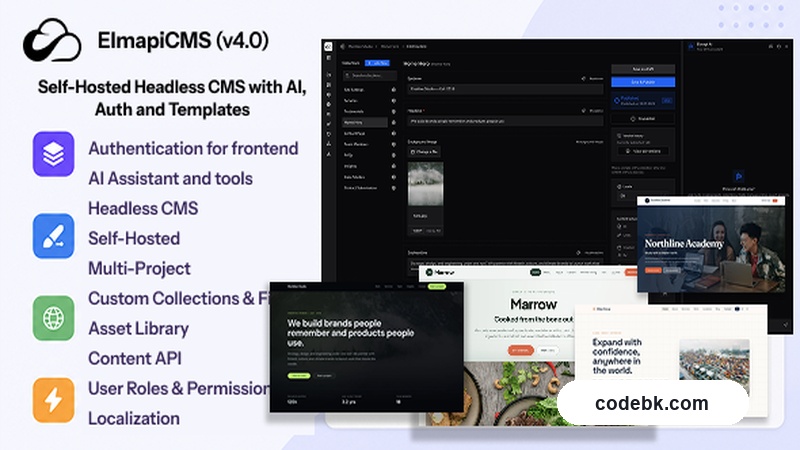
The platform ships with pre-built frontend templates. You're not staring at a blank React project wondering where to begin. The templates are clean, modern, and responsive out of the box, built with Tailwind so tweaking the look feels natural rather than painful.
The real flexibility lives in how content models are defined. Instead of fighting a page builder for pixel-perfect control, you define content types, fields, and relationships in the admin panel, then consume them through a well-organized API. That's the headless philosophy done right — structure first, presentation second.
Inertia.js is the glue here. It lets you build the frontend as if it were a traditional server-rendered app, but you get the SPA experience without the complexity of managing API calls everywhere. For a dev who's spent years wrestling with WordPress template hierarchies, this feels like taking off a heavy backpack.
Practical Functionality
Authentication & Multi-Tenant Ready. This is where ElmapiCMS pulls ahead of most self-hosted options. User auth is baked in — registration, login, password resets, role-based access. If you're building a platform that needs customers, editors, and admins all operating in the same system with different permissions, you don't need a separate plugin or third-party service.
Content Versioning. Every piece of content you publish gets tracked. Change history, rollback capability, draft-to-publish workflows. This matters more than people admit until they're trying to fix something a contractor broke at 2 AM on a Friday.
AI-Assisted Publishing. The AI integration isn't a gimmick either. It's positioned where it actually helps — content generation assistance, auto-tagging, smart suggestions when you're structuring new entries. It won't replace a human writer, but it cuts down friction on repetitive tasks and helps less experienced team members produce consistent content.
Frontend Templates Included. The demo templates cover common use cases: a blog/content hub, a SaaS landing page style layout, and a dashboard-style admin area. They're built with React and Tailwind, fully responsive, and designed to be extended rather than reinvented. If you need something custom, the component structure makes it straightforward.
API-First by Design. Every content piece is accessible through a clean REST API. Frontend consumption is trivial whether you're building a React SPA, a Next.js site, a mobile app, or even feeding data back into a WordPress install that just needs a different content source.
Technical Specifications
| Specification | Detail |
|---|---|
| Core Framework | Laravel 13 |
| Frontend Stack | React, TypeScript, Inertia.js, Tailwind CSS |
| Database | MySQL / PostgreSQL (Laravel migration support) |
| Authentication | Built-in (registration, login, RBAC, password reset) |
| Content Versioning | Yes — full change history and rollback |
| AI Integration | Content generation assistance, auto-tagging, smart suggestions |
| Templates Included | Multiple pre-built frontend templates |
| API | Full REST API for all content models |
| Self-Hosted | Yes — full ownership, no subscriptions required |
| Documentation | Included with installation guide and API reference |
Final Takeaway
ElmapiCMS 4.0 isn't for everyone. If you need a visual drag-and-drop page builder and the ability to hand a site over to a non-technical editor, this isn't your play. But if you're a developer or agency that values a proper content layer with real authentication, versioning, and a clean API — and you want to stop patching together WordPress + plugins just to get headless functionality — this is a genuinely solid option.
The Laravel + React stack is mature and well-documented. The included templates save real time. And the fact that it's self-hosted means you own your data completely, with zero recurring platform fees. That last point alone is worth the switch for a lot of shops tired of subscribing to hosted CMS solutions that raise prices every other year.
It's the kind of tool I'd reach for before spinning up another WordPress multisite just to handle a few extra requirements.