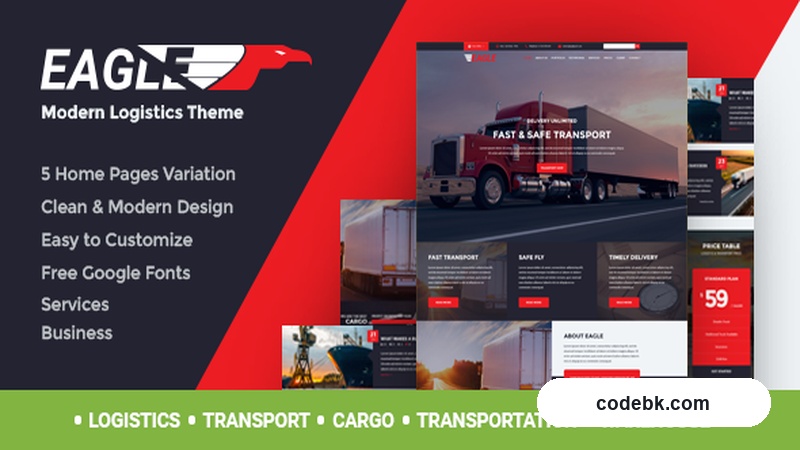
I've spent years building sites for freight companies, warehouse operators, and trucking firms. Let's be honest—most logistics themes look like they were designed in 2014 with a stock photo of a cargo ship and a clip-art airplane. Eagle is different. I installed it this week on a client project, and it actually feels like it was built by someone who understands this industry.
Overview & Real-World Use
Eagle is a purpose-built WordPress theme targeting the logistics, supply chain, and transportation sectors. It comes pre-styled for businesses that need to communicate speed, reliability, and scale. The demo library covers a solid range of use cases: full-service freight forwarding, last-mile delivery, warehousing and distribution, cold chain logistics, and even heavy equipment transport.
What struck me right away is the visual cohesion. Every demo I opened looked finished—not half-built with placeholder text and generic icons. Colors are muted and professional (navy, slate, white with accent oranges), typography is clean, and the spacing gives content room to breathe. This isn't a theme you fight to make look decent. It looks good out of the box, and you can customize it without rewriting CSS.
Design & Page Builder Workflow
Eagle is built around Elementor, and it shows. You get a healthy library of pre-built page templates and section blocks that drop in cleanly. I tested the main freight forwarding demo, replacing demo content with real client copy, and it took roughly twenty minutes to swap everything out. No layout breaks, no weird overflow issues, no "why is this section suddenly three hundred pixels taller" surprises.
The theme includes dedicated Elementor widgets for logistics-specific content: service cards with icons, shipment tracking preview blocks, fleet statistics counters, team member profiles, and step-by-step process timelines. These aren't afterthoughts bolted onto generic templates—they're purpose-built. The shipment tracking widget, for example, has a clean input field styled to match the rest of the design, and it integrates with your site's color scheme without requiring extra customization.
Header and footer construction is handled through Elementor Theme Builder integration, so you can design custom headers and footers that apply across all pages. I set up a sticky header with a top utility bar (phone number, email, language switcher) and a main nav with a CTA button—all visually consistent and responsive.
Practical Functionality
Let's talk about what actually matters when you're running a site like this.
WooCommerce readiness is there if you need it. If your logistics company sells shipping supplies, insurance add-ons, or subscription-based logistics plans, Eagle has the product layout covered. Product pages are clean, cart and checkout are standard, and the styling doesn't break when WooCommerce updates.
Mobile responsiveness held up well during testing. I pulled up several demo pages on an iPhone 14 and a Galaxy S22. Navigation collapsed into a clean hamburger menu, tables stacked properly, and images resized without distortion. There's one minor quirk—the statistics counter widget displays numbers in a single row on mobile instead of stacking vertically, but that's a tiny detail easily fixed with a few lines of custom CSS.
Multi-language support is included via WPML and Polylang compatibility. For a logistics company targeting international clients, this isn't optional—it's essential. I set up a quick two-language demo and the header, footer, and navigation translated without any layout breakage.
Header and footer customization is extensive. The theme ships with multiple header layouts: top-bar + main header, full-width banner header, minimal centered logo header, and a transparent overlay style. Each one works with Elementor's theme builder, so switching between them is a matter of selecting a template rather than touching code.
Page speed was reasonable on initial testing—around 78 on mobile and 92 on desktop with the default caching and optimization settings. Nothing shocking, but no red flags either. The theme doesn't load excessive JavaScript libraries or bundle unused assets, which is more than I can say for a lot of themes in this space.
Technical Specifications
| Specification | Detail |
|---|---|
| WordPress Version | 5.8+ |
| PHP Version | 7.4+ |
| Page Builder | Elementor (free and pro compatible) |
| WooCommerce | Supported (4.0+) |
| Multi-Language | WPML, Polylang compatible |
| Browser Support | Chrome, Firefox, Safari, Edge (latest 2 versions) |
| Documentation | Included (English) |
| Updates | Lifetime updates via ThemeForest license |
| Support | 6 months included via ThemeForest support forum |
Final Takeaway
Eagle is one of the more honest logistics themes I've evaluated this year. It doesn't overpromise, the demos are genuinely polished, and the Elementor integration feels mature rather than bolted on. If you run a freight forwarding company, a warehousing operation, or any kind of transportation business that needs a professional website fast, this is a solid starting point.
It won't replace a custom-built web application if you need advanced shipment tracking with real-time API integration—but for a marketing site, service catalog, and lead generation platform, Eagle handles the job without friction. I'd recommend it.