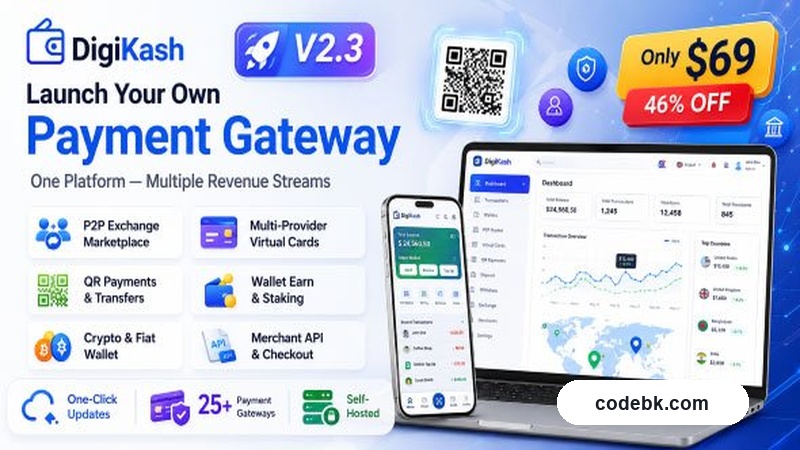
Overview & Real-World Use
DigiKash is a self-hosted fintech stack built on Laravel that lets you run your own payment gateway, crypto wallet, and fiat digital wallet all from a single server. Think of it as a white-label infrastructure play — whether you're building a neo-banking brand, a P2P exchange, or a digital money transfer service, this script gives you the skeleton without handing over any recurring SaaS fees.
I've spent enough time wrangling payment plugins and wrestling with third-party gateway APIs to appreciate when something actually works out of the box. DigiKash hits that mark. It covers the full cycle: sending and receiving funds, QR-based payments, virtual card issuance, and even a built-in P2P exchange engine. For a solo founder or a small agency that wants to own the stack instead of renting one, that's a serious value proposition.
One thing to flag upfront: this version is nulled, meaning the license checks have been stripped. That carries its own risks — no guaranteed updates, no support channel, and potential security blind spots — so treat it as a development or staging asset rather than something to push straight into production.
Design & Page Builder Workflow
The platform leans into a clean, modern fintech aesthetic that feels right at home in the Stripe-adjacent design space we've seen dominate the last few years. The UI is dashboard-heavy by nature — payment gateways demand operational clarity — and DigiKash doesn't fight that. Admin panels are structured, data-dense, and intentionally minimalist.
There's no drag-and-drop page builder attached to this one since it's a Laravel application rather than a WordPress theme. Layout flexibility comes through Blade templates and configuration panels rather than Elementor or Gutenberg. That's actually a good thing here — fintech backends need consistency, not every admin section rearranged by some random template. You work within the structure the framework gives you, and you customize through code or config, which is where most developers end up wanting to be anyway.
Pre-built flows are handled through demo datasets and module toggles rather than theme demos. You enable what you need — wallet, exchange, card issuance — and the system adapts. It's functional over fancy, which is exactly the right call for this category.
Practical Functionality
Let me walk through what actually matters when you're running this live.
Payment Gateway Core: You can process incoming and outgoing transactions, accept QR payments, and manage settlement flows. The gateway supports both fiat and crypto routing, which means a single dashboard handles everything from a standard bank transfer to a USDT swap. That's unusual to find bundled this cleanly.
Crypto & Fiat Wallets: Dual wallets sit behind the same authentication layer. Users get a crypto address book, transaction history, and balance tracking alongside a traditional fiat ledger. The separation is clean in the codebase, and swapping between wallets doesn't require switching dashboards.
P2P Exchange Engine: This is where DigiKash pulls ahead of a lot of lighter fintech scripts. The built-in P2P module lets users trade directly — peer-to-peer — with rate locking, escrow-like hold mechanics, and dispute tracking. Setting up a marketplace where users trade crypto for fiat (or other crypto) without you touching the funds is a sophisticated feature set, and it works without needing a separate order management system bolted on.
Virtual Cards: Card issuance is handled in-platform. Users can request virtual cards, set spending limits, and use them for online purchases. The integration point here matters — if you're planning to connect this to a real card provider like a Visa or Mastercard partner API, you'll want to validate that endpoint compatibility before going live.
Multi-Language & Localization: The system supports multilingual routing through Laravel's localization layer. If your target market spans multiple regions, you're not locked into a single language. Currency settings and locale formatting follow suit.
QR Payments: Static and dynamic QR generation is included. Merchants can print QR codes, share them digitally, and track redemptions in real time. The QR system integrates with the wallet layer so scan-to-pay is instantaneous.
From a hands-on perspective, the thing that impressed me most is the coherence. A lot of these scripts feel like five different projects stitched together. DigiKash reads like one team planned the whole architecture before writing a single line. Modules talk to each other cleanly, permissions flow logically, and the admin panel doesn't feel like it was cobbled together across three sprints.
Technical Specifications
| Specification | Detail |
|---|---|
| Framework | Laravel |
| PHP Version | 8.0+ (recommended 8.1+) |
| Database | MySQL / MariaDB |
| Payment Gateway | Built-in (extensible API layer) |
| Crypto Support | Multi-chain wallet engine |
| P2P Exchange | Integrated module |
| Virtual Cards | Issuance & management built in |
| QR Payments | Static & dynamic QR support |
| Multi-Language | Laravel localization ready |
| Responsive Design | Yes, mobile-first dashboard |
| Nulled Status | License requirements removed |
| Documentation | Included with download |
Final Takeaway
DigiKash v2.3.2 is a legitimately capable fintech platform if you're comfortable working with Laravel and understand the operational risks of running a nulled script. The feature set — particularly the bundled P2P exchange and dual crypto/fiat wallets — punches well above what you'd typically find at this price tier, and the architecture feels intentional rather than patchwork.
It's best suited for developers and agency owners who want a self-hosted payment infrastructure they can modify, extend, and brand without subscription constraints. If you need a turnkey, supported product with guaranteed security audits, look elsewhere. If you're building something experimental, running it in a controlled environment, or have the in-house PHP talent to harden and maintain the installation, this is worth a serious look.
Just don't skip the security review before anyone deposits real money into it.