Overview & Real-World Use
I've built a fair number of restaurant sites over the years, and more often than not the client walks in saying something along the lines of, "I don't just want a menu page. I need the whole vibe." Basilico was clearly designed with that exact brief in mind. It's not a single-purpose "pizza joint" template. You get layout variations that cover a café, a bakery, a bar, and a proper fine-dining hotel restaurant, all under one package. That breadth matters when you're a small agency juggling five different hospitality clients and don't want to scramble for a new starting point every time.
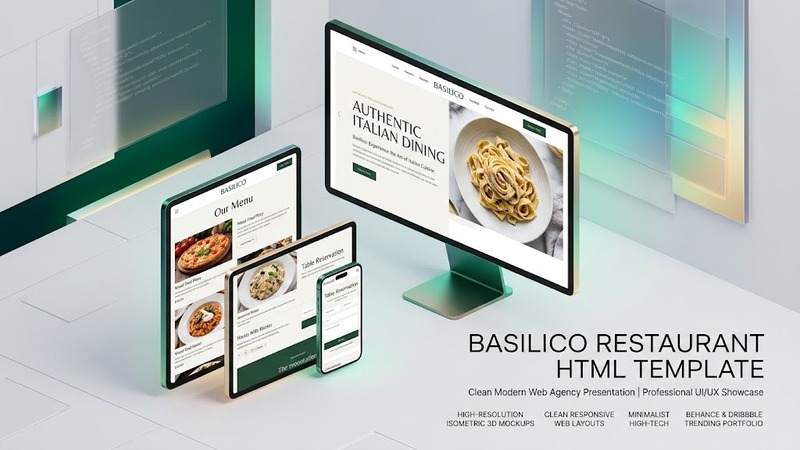
The visual language leans into that clean, slightly upscale direction. Think generous whitespace, muted earth tones, and typography that reads as "artisanal bistro" rather than "all-caps buffeteria." If your target is a mid-to-upper-end restaurant, a boutique hotel's on-site eatery, or a specialty coffee shop that wants to look like it belongs on a design blog, this is squarely in the right lane. It won't suit a loud, neon-lit sports bar. Keep that in mind before you buy.
Design & Page Builder Workflow
Since this is a pure HTML/CSS/JS template rather than a CMS-bound theme, the "builder" conversation shifts a bit. You're working with the pre-constructed demo pages directly—each one is a complete, self-contained layout you can open in a browser, strip the placeholder content, and restructure via the markup. The layout system is grid-based and modular, so swapping out a full-width hero for a split-image-and-text section is a matter of rearranging container divs rather than fighting a page-builder's drag-and-drop quirks.
If your client ultimately needs WordPress underneath, you'd drop these HTML files into a child theme or use them as the structural reference for a custom theme. The classes are consistent enough that mapping them into a WP loop doesn't require a full redesign. I've done this workflow before with similar hospitality templates, and it saves roughly two to three days of pixel-pushing that you'd otherwise spend in a builder.
One thing I appreciated: the demo pages include a restaurant interior gallery, a detailed menu section (with dietary tags and price alignment handled in the CSS), an "about the chef" block, a reservation/booking form layout, and a straightforward contact-and-hours page. You don't have to cobble the core sections together from scratch.
Practical Functionality
Under the hood, Basilico relies on standard front-end stack: semantic HTML5, a modern CSS framework (the grid and utility classes follow a Bootstrap-adjacent pattern), and vanilla JavaScript with a few light plugins for sliders, image lazy-loading, and smooth scroll behavior. There's no jQuery dependency dragging down the load, which I like seeing in 2024–2025-era templates.
Responsiveness is handled through mobile-first media queries. I checked the tablet and phone breakpoints on a few of the demo pages—the nav collapses into a hamburger, the menu list reflows into a single column, and the hero images scale without losing their aspect ratio. No janky horizontal scroll on a 375px viewport. Good.
The reservation form is a front-end layout with no backend logic baked in, which is expected for an HTML template. You'd wire it up to your own endpoint, a form service, or a lightweight PHP mail script depending on the hosting stack. Same goes with any "view menu" print-friendly page they include—CSS print stylesheets are already in place, just add the trigger button.
Typography throughout uses a pairing of a clean sans-serif for UI elements and a slightly characterful serif for headings. The font files are included (woff2), so you're not relying on a third-party CDN that could flake during a client's site launch.
Technical Specifications
| Item | Details |
|---|---|
| Markup | HTML5 (semantic tags, ARIA landmarks) |
| Styling | CSS3 with responsive grid; media queries at 576 / 768 / 992 / 1200 px |
| Scripting | Vanilla JS + lightweight slider & lazy-load plugins (no jQuery required) |
| Fonts | Bundled woff2 files (no external CDN dependency) |
| Browser support | Latest Chrome, Firefox, Safari, Edge |
| Included demos | Café, Bakery, Bar, Fine-Dining Restaurant / Hotel |
| Documentation | PDF quick-start guide (file structure, how to swap images, form hookup notes) |
| License | Standard commercial / single-use (verify terms in the package README) |
| CMS requirement | None (pure HTML; pair with WordPress, Ghost, or static hosting as needed) |
Final Takeaway
Basilico isn't trying to be everything. It's a solid, well-organized starting kit if you need to stand up a hospitality-focused website fast—whether that's a single restaurant, a small hotel property, or a chain of cafés sharing a brand identity. The multi-concept demo pages save you real time, the code is clean enough that you won't spend hours untangling spaghetti CSS, and the responsive output holds up without a ton of manual overrides.
I'd grab this for a client project where the budget covers a lightweight custom build but not a full WordPress theme license, or when you want pixel-level control over the final output. If your client specifically needs WooCommerce product pages, member dashboards, or a CMS the marketing team can self-serve, look elsewhere—this is a front-end layout package, and it's doing that job well.