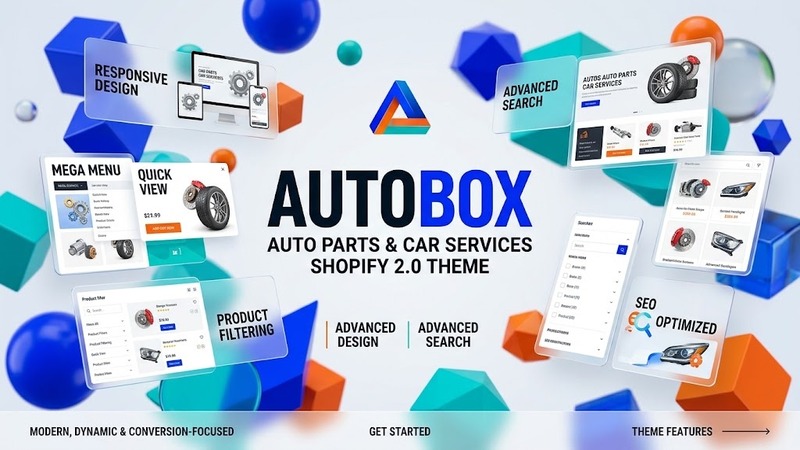
Overview & Real-World Use
I've been building and running online stores for more than a decade now, and the automotive niche has always been one of the trickier ones to get right online. You've got massive SKUs, complex filtering needs, buyers who know exactly what they're looking for, and zero patience for a clunky checkout. That's exactly where Autobox comes in.
Autobox is a Shopify 2.0 theme built specifically for auto parts retailers, car accessory shops, vehicle service centers, and aftermarket suppliers. It's not a generic store theme that's been slightly recolored — it's purpose-built for a catalog-heavy, conversion-focused automotive business. Think engine components, tires, car electronics, detailing kits, and the like. The whole thing runs on Shopify's latest OS 2.0 framework, which means you get the modern app ecosystem, native section support everywhere, and decent page-load speeds right out of the box.
If you're setting up a professional auto parts storefront and want something that looks credible from day one without spending weeks on custom development, this is a solid starting point.
Design & Page Builder Workflow
What stands out first is the layout approach. Autobox ships with multiple pre-built demo templates targeting different sub-niches within automotive — a parts-focused layout, a service-center landing page, a detailing products store, and so on. You import one, and your homepage is essentially done. No pixel-pushing required.
The theme integrates with Shopify's native online store builder (no separate drag-and-drop page builder required), which is actually a relief. Too many themes force you into a third-party builder that slows things down or creates compatibility headaches. With Shopify 2.0 sections anywhere, you're rearranging content blocks the same way you'd rearrange furniture — drag, drop, done. Header, footer, product pages, collection grids, blog layouts — everything's modular.
The visual style leans clean and technical, which is exactly the right tone for this audience. Dark accents, clear typography, high-contrast CTAs. It doesn't try to be flashy. It tries to be trustworthy, and for people shopping for brake pads or alternators, that matters more than anything.
Practical Functionality
Let's talk about what actually runs the store.
Catalog & Filtering: Auto parts stores live or die by their product filtering. Autobox includes advanced filtering tools — by vehicle make, model, year, part type, price range, and more. You can set up layered navigation that doesn't crash the page or force awkward redirects. This is critical. A buyer looking for "2018 Honda Accord brake pads" isn't going to stick around if they can't narrow things down fast.
Product Page Design: The single product template is built to handle detailed specs. You've got space for compatibility tables, technical diagrams, bulk pricing tiers, and related parts cross-sells. The layout keeps the "Add to Cart" button prominent without feeling aggressive. That balance is hard to get right, and Autobox handles it well.
Header & Footer Controls: Full control over the header and footer through the Shopify theme editor. Mega menus, top announcement bars, quick links, contact info — everything's accessible without touching code. If you need a sticky cart icon or a phone number in the header during business hours, that's a setting away.
Mobile Performance: The theme is fully responsive, and more importantly, it's optimized for mobile load speed. A lot of automotive shoppers are on their phones — often looking up a part number while standing next to their car. Autobox keeps the experience tight on small screens with collapsible navigation, touch-friendly buttons, and lightweight asset delivery.
Multi-Language & Currency: Built-in support for multiple languages and currencies, which matters if you're sourcing parts internationally or selling across borders. Shopify's own language and currency features plug in cleanly here.
SEO Fundamentals: Schema markup for products, optimized URL structures, fast Core Web Vitals scores, and clean heading hierarchies are all baked in. You're not starting from scratch on the SEO front.
Technical Specifications
| Specification | Details |
|---|---|
| Framework | Shopify OS 2.0 |
| PHP Version | N/A (Shopify-hosted) |
| WordPress Compatibility | N/A (Shopify-only theme) |
| Bundled Plugins | None required — uses native Shopify features |
| Required Apps | Optional: translation, reviews, or email marketing apps |
| Documentation | Included with purchase |
| Support | Via themelock support channels |
| Browser Support | All modern browsers |
| Last Updated | August 2026 |
Final Takeaway
Autobox is a straightforward, no-nonsense Shopify theme that does exactly what it promises — it gives automotive businesses a professional, fast, and filter-rich storefront without requiring a developer on retainer. The Shopify 2.0 foundation means it's built for the present, not stuck in legacy patterns. Pre-built demos save hours of setup time, and the filtering logic alone is worth the price if you're running a large parts catalog.
It's best suited for auto parts sellers, car accessory retailers, and vehicle service businesses who want to launch quickly and scale cleanly. If you're running a tiny single-product shop, overkill — but if you've got hundreds of SKUs and need a store that doesn't make your buyers work to find what they need, Autobox is a strong pick.